Hi there 👋
Codeslog - an eternal learner’s growth chronicle.
Real journeys over perfect tutorials.
Where small records accumulate into great assets.
Introduction This is the sixth post in the WCAG 3.0 series. This time I want to unpack what “beyond the web” actually means in practice. The earlier posts looked at structure, testing, and Assertions — now it’s time to get clear on “how far does the scope actually reach?” Important: This post is based on the WCAG 3.0 Working Draft (2026-02-20). The Draft is subject to change, and this post may be updated accordingly. ...
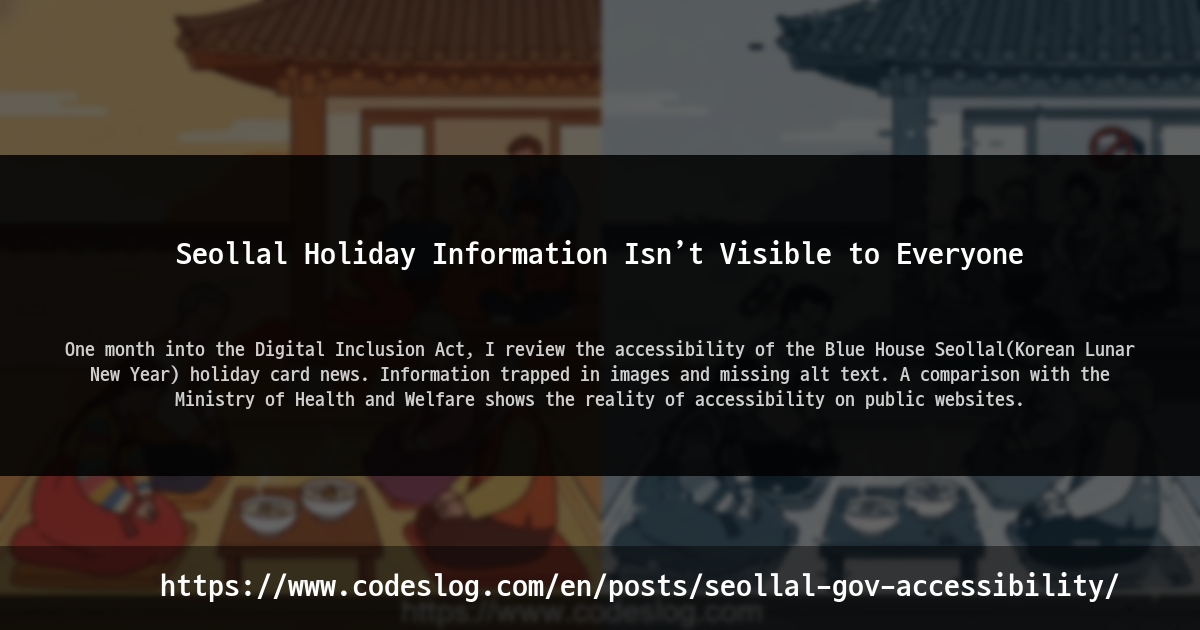
This essay records what I have wrestled with on the ground about web accessibility, public web services, and the responsibilities of developers. Between law and technology, standards and reality, I try to answer the question: “Are we truly building for everyone?” Is today’s Seollal(Korean Lunar New Year) really providing equal information to everyone? Produced by: Nano Banana Ahead of the Seollal(Korean Lunar New Year) holiday, I browse the web to find helpful information. Seollal(Korean Lunar New Year) is a uniquely Korean holiday. As I visit site after site, the first thing I often encounter is an auto-rotating banner or card news. Around Seollal, these banners include important government notices like emergency information. ...
Since I started this blog, I have written in several directions. The areas I keep digging into are web accessibility and frontend. I want to write more, and new ideas keep coming, but the speed of writing is not as fast as I hope. Right now I still have eight unfinished drafts. Starting is easy, but wrapping up always feels surprisingly hard. AI has made research and organization much faster, but my time and energy are still limited, so it often feels frustrating. I work during the day, and after work I take care of family responsibilities, side projects, this blog, and certification prep. Honestly, I wish I had ten bodies. ^^;; Still, I want to keep going, so today I am writing a candid note about how I approach blog writing. ...
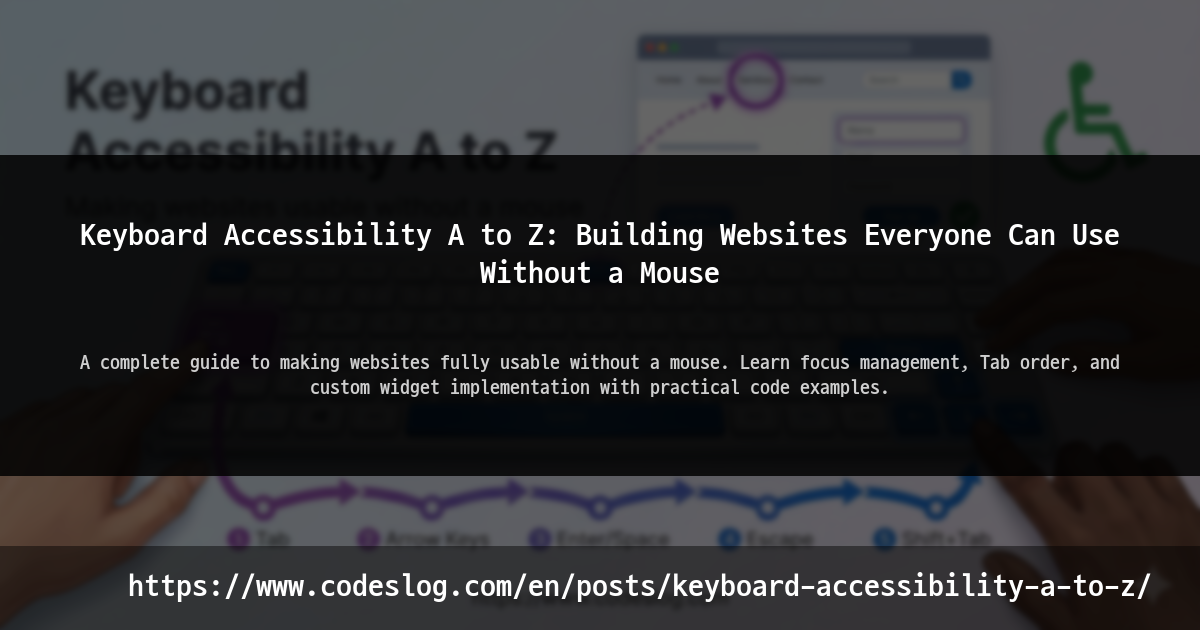
Introduction Have you ever tried using the internet without a mouse? Most people take their mouse for granted. But there are many people who can’t use one. People with physical disabilities who can’t operate a mouse People with repetitive strain injuries like carpal tunnel syndrome People with temporary arm injuries Power users who simply find keyboards more efficient For these users, the question “Can I use this site with just a keyboard?” is crucial. ...
Introduction In Atomic Tests vs. Holistic Tests: A New Testing Methodology, we discussed balancing Atomic and Holistic tests. Now we need to address how we’ll “assert” and “document” these results. This is where Assertions come in. The scoring and conformance model covered in WCAG 3.0 Conformance Model: Changes After A/AA/AAA also connects with Assertions. This is because they provide a way to supplement areas not covered by quantitative tests with organizational processes and evidence. ...
Introduction When running a static blog, “scheduled publishing” and “build limits” often become problems at the same time. In particular, building on every commit can easily hit build limits on platforms like Cloudflare Pages. In this post, I’ll walk you through the approach I’m actually using: running a publish check with GitHub Actions every 3 hours to handle scheduled publishing. The key idea is “check only at set intervals, and publish only when needed.” ...
Introduction When people hear “accessibility testing,” they often think of a checklist: “Does this button have alternative text?” “Is the contrast ratio high enough?” WCAG 2.2 is built around clear pass/fail checks like these. WCAG 3.0 moves toward a broader unit of evaluation, aiming to consider overall user experience quality. That shift naturally changes how we test. We now combine fine-grained checks (Atomic) with real-world contextual evaluation (Holistic). This shift directly connects to the score-based conformance model discussed in WCAG 3.0 Conformance Model: Beyond A/AA/AAA. The weight you give each test type can change the score and the level you reach. ...
Introduction In the previous post, we looked at why WCAG 3.0 reorganized “Success Criteria” into “Outcomes.” This post focuses on changes to the conformance model. WCAG 3.0 aims for a different approach than WCAG 2.x, but it is still in the Editor’s Draft (2026-01-05) stage and is not finalized. Conformance levels, scoring approaches, and evaluation methods are still being explored. Important: This post is based on the WCAG 3.0 Editor’s Draft (2026-01-05). The draft can change at any time, and the document itself is explicitly marked as a work in progress. ...
Introduction Running a blog in both Korean and English revealed an interesting problem. When sharing blog links internationally, visitors often land on the Korean page. Those who can’t read Korean are confused, right? Similarly, when Korean readers click on English post links shared in Korean communities, they face the same issue. While there’s a language switcher button in the header, new visitors often struggle to find it. This isn’t user-friendly, and from an accessibility perspective, it’s not ideal either. ...
Developers often make the same mistake after learning ARIA. They understand the concept, but they are unsure when and how to apply it in real projects. ARIA practical guide main visual with ARIA attributes highlighted in a code editor Cover image example: visual that symbolizes applying ARIA attributes · Generated by Nanobanana AI You may have heard the phrase: “ARIA is a last resort.” Use semantic HTML first, and add ARIA only when native HTML is not enough. This guide follows that principle and shows how to use ARIA effectively in real work. ...